Why our website is a painting
Abstract
We wanted the first thing people see of Grove to earn their trust, so we borrowed the eye of a nineteenth-century Tuscan master.
Grove builds systems that help organisations understand themselves. That is a claim about care and judgement, and a website cannot prove it in a sentence. It can only show it.
So we asked a simple question: what would a visitor trust at a glance? Not a gradient. Not a diagram of nodes and arrows. Not a picture made in seconds by a machine. We wanted something that had been looked at closely, by someone who knew how to look.
A master's eye
The painting on our home page is Tra gli ulivi a Settignano, by Telemaco Signorini, from around 1885.1 Signorini was one of the Macchiaioli, the painters in Florence who left the studio to work outdoors and built their pictures from patches of light and shade.
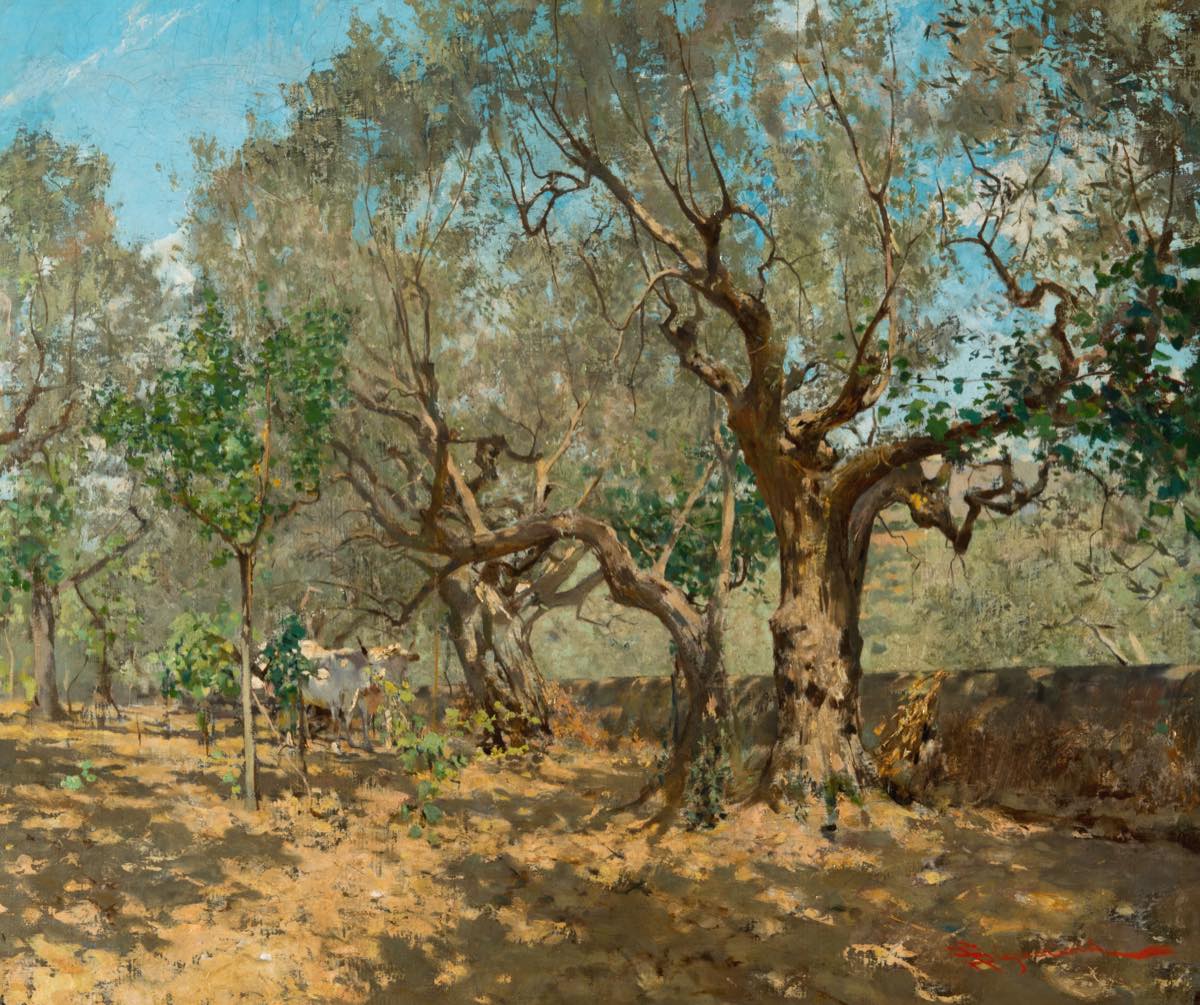
We did not choose it because olive trees match our name, although they do. We chose it because of what the Macchiaioli were doing. They looked hard at ordinary things, and they painted what was in front of them, not what they were expected to see. That is the habit we want to help organisations build.
Painted again, every day
The page does not show a photograph of the painting. It repaints it, stroke by stroke, in your browser. Every stroke takes its colour from Signorini's canvas and its direction from the shapes he painted, so the picture stays his. Each day a different hand does the work, and the light follows your own sky: dawn at your sunrise, blue dusk at your sunset.
The words get bare ground
Wherever our words sit, the paint thins out to bare primed panel. The page measures where the text is and keeps the brush away from it. It is a small rule, but it says something we care about: the work should make room for people, not the other way round.
A website is a small thing. But it is the first thing, and we wanted ours made the way we intend to make everything else: slowly, with care, and with credit to the people whose work we build on.
Notes
- The painting is undated; it is usually placed around 1885. It is in a private collection and in the public domain. Back to the text